In mixed martial arts, not every competition produces a clear winner. A fight can end in a draw, judges can disagree, or a competition can finish with both teams having identical results.
In MMA Trio, a proposed three-on-three mixed martial arts format, deciding what happens when teams finish tied could become an important part of developing the sport.
Imagine two teams competing in a three-on-three event. Each team wins one individual matchup, while the remaining matchup ends in a draw. Which team should advance? Should the competition end in a tie, or should there be another way to determine the winner?
These questions would need to be addressed before MMA Trio could establish a consistent competition format.
Let’s explore how draws, tied scores, overtime, and possible tie-breakers could work in a three-on-three MMA competition.
What Is a Draw in MMA Trio?
A draw occurs when a competition ends without either competitor or team being declared the winner.
In traditional MMA, a draw can occur when judges cannot determine a winner under the applicable scoring rules. A fight may also end in a technical draw under certain circumstances.
In a proposed MMA Trio format, draws could occur in several ways.
For example:
- Two individual fighters receive an equal score.
- Both teams finish with the same number of individual victories.
- The combined team scores are identical.
- A competition is stopped under circumstances that prevent a winner from being determined.
The rules would need to distinguish between an individual draw and an overall team draw.
These are not necessarily the same situation. A team could have an individual bout ending in a draw while still winning the overall competition based on its other results.
How Could an MMA Trio Team Draw Happen?
There are several possible situations in which two teams could finish with equal results.
1. Both Teams Win One Individual Fight
Imagine two teams competing in three separate individual bouts.
Team A:
- Fighter 1 wins.
- Fighter 2 loses.
- Fighter 3 wins.
Team B:
- Fighter 1 loses.
- Fighter 2 wins.
- Fighter 3 loses.
In this example, Team A wins two individual bouts, while Team B wins one. There is no overall tie.
However, if each team wins one bout and the remaining bout ends in a draw, the competition could require a specific procedure to determine whether the event is declared a team draw or whether another method is used.
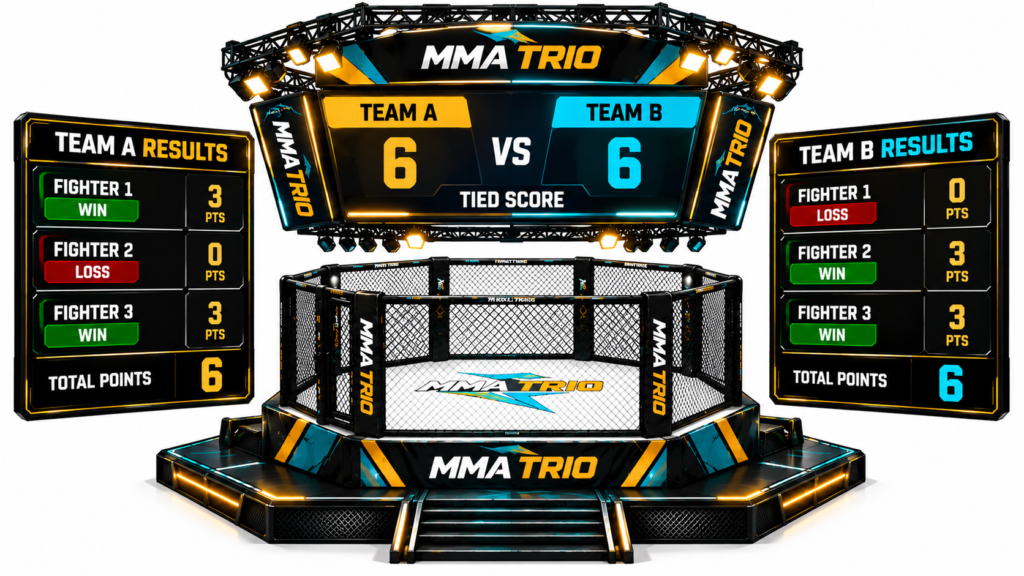
2. Both Teams Finish With Equal Points
Under a proposed team-points system, both teams could finish with exactly the same total.
For example:
Team A: 6 points.
Team B: 6 points.
Neither team would have an advantage based on the combined score.
Organizers would need to decide whether the result remains a draw or whether a predetermined tie-breaker is used.
For more on possible scoring systems, read MMA Trio Team Scoring vs. Individual Scoring: Which System Makes Sense?.
3. A Fight Ends Before a Winner Can Be Determined
An individual bout might be stopped because of an accidental injury, equipment problem, or another circumstance that prevents the competition from continuing.
Depending on the circumstances and the applicable rules, officials might declare a technical decision, technical draw, no contest, or another result.
A future MMA Trio ruleset would need to establish how these outcomes affect the overall team competition.
Five Possible Tie-Breaker Systems for MMA Trio
If organizers decide that every competition should produce a winner, they could consider several possible tie-breaking methods.
1. Additional Individual Bout
One possibility would be an additional individual bout between designated representatives of the two teams.
For example, each team could select one qualified fighter to compete in an additional match under predetermined rules.
The winner would determine which team advances or wins the competition.
However, this approach would require careful consideration of fighter eligibility, weight differences, recovery time, and medical clearance.
A fighter who has already completed a demanding bout should not automatically be required to compete again.
2. Aggregate Individual Scoring
Another possibility would be to compare the combined individual scores from all three fighters.
Instead of looking only at the number of victories, judges could calculate the total scores earned by each team under a clearly established scoring system.
For example:
- Team A finishes with a combined score of 145.
- Team B finishes with a combined score of 138.
Under this hypothetical system, Team A would win based on the higher aggregate score.
This method could avoid requiring fighters to compete in an additional bout.
However, the scoring criteria would need to be established before competition begins, and judges would need consistent procedures for calculating the totals.
3. Overtime Competition
A third possibility would be a predetermined overtime period.
Instead of requiring another full individual fight, organizers could consider a shorter additional competition period under clearly defined rules.
The overtime format would need to explain:
- Which fighters would participate.
- How long the additional period would last.
- Which techniques and actions would be permitted.
- How judges would determine the winner.
- What would happen if the overtime period also ended in a tie.
Any overtime system would need to account for fighter fatigue, medical considerations, and the risks of additional competition.
4. Predetermined Team Performance Criteria
Organizers could establish additional judging criteria to determine which team performed better overall.
These criteria might consider the established scoring results of the individual bouts rather than introducing subjective measures of teamwork.
For example, a tie-breaking procedure could compare the number of individual rounds won, provided the rules clearly explain how rounds are scored and compared.
The advantage would be that the competition could potentially be decided without another fight.
The disadvantage would be that spectators might find additional calculations confusing unless the system is explained clearly.
5. Declare the Competition a Draw
Another option would be to accept that some competitions should end without a winner.
Not every sporting event needs an additional round or tie-breaking procedure.
If neither team has established a clear advantage, declaring a draw could be the fairest outcome.
This approach would also avoid placing additional physical demands on athletes who have already completed their competition.
A future MMA Trio ruleset could allow draws during regular events while establishing different procedures for tournament competitions where advancement requires a winner.
Should MMA Trio Use Overtime to Decide a Winner?
Overtime might seem like an exciting way to resolve a tied competition, particularly during a tournament or championship event.
Spectators often enjoy seeing competitors settle a close contest through additional competition.
However, combat sports present safety concerns that would need to be considered.
Fighters may already be physically exhausted after completing their individual bouts. Requiring them to compete again could increase the risk of injury and impair their ability to defend themselves.
If overtime were considered, it should have clearly defined limits and require appropriate medical oversight.
Organizers would also need to decide whether overtime should involve one representative from each team or another approved competition arrangement.
The most important consideration should be athlete safety rather than simply guaranteeing a winner.
How Could Knockouts and Submissions Affect Tie-Breakers?
Knockouts and submissions could influence the overall result depending on how the scoring system is designed.
For example, if individual victories are the primary method of determining team results, a knockout or submission could count as an individual victory.
However, organizers would need to decide whether the method of victory has any additional effect on team scoring.
A fighter winning by knockout should not automatically receive additional team points unless that possibility is specifically included in the rules.
The rules would also need to explain how medical stoppages and other interrupted bouts affect the team’s final result.
For more on this subject, read MMA Trio Knockouts and Submissions: How Could They Affect the Team?.
How Would Judges and Officials Handle a Draw?
Officials would play an important role in resolving tied competitions.
A proposed MMA Trio ruleset could establish procedures covering:
- How individual draws are recorded.
- How individual results contribute to team standings.
- How combined team scores are calculated.
- When a competition can officially end in a draw.
- Which tie-breaking procedures apply during tournaments.
- How medical stoppages affect competition results.
Judges should not have to invent a tie-breaking procedure after a competition has already ended.
All possible outcomes should be explained to teams, coaches, officials, and spectators before the event begins.
For more on the responsibilities of officials, read MMA Trio Referees and Safety: How Could Officials Control a 3-on-3 Fight?.
Would Tournament Competitions Need Different Tie-Breaker Rules?
A regular exhibition or team competition might allow both teams to finish with a draw.
A tournament could be different.
If two teams are competing for a place in the next round, organizers would need a method for determining which team advances.
Possible tournament procedures could include:
- A predetermined tie-breaking scoring system.
- An approved additional bout between medically cleared fighters.
- A previously established aggregate scoring method.
- Another clearly defined procedure appropriate to the tournament format.
The procedure should be announced before the tournament begins.
It would also be important to ensure that teams receive equal treatment and that no competitor is placed at an unfair disadvantage because of the tie-breaking rules.
What Would Be the Fairest Way to Decide an MMA Trio Winner?
There may not be one perfect solution for every competition.
However, a practical approach could involve using the following principles:
1. Use individual results first.
Each fighter’s performance should contribute to the team’s overall result under clearly established scoring rules.
2. Establish team scoring in advance.
The competition should explain exactly how individual victories, draws, and losses affect the team score.
3. Allow draws when appropriate.
Regular competitions should not necessarily require an additional fight if the result is genuinely tied.
4. Establish tournament tie-breakers.
Championship and elimination events could use predetermined procedures to identify which team advances.
5. Put fighter safety first.
No tie-breaking method should require athletes to compete when they are injured, medically unfit, or inadequately recovered.
This approach could provide a foundation for discussing fair and consistent competition procedures.
Frequently Asked Questions
Can an MMA Trio competition end in a draw?
Yes. A proposed MMA Trio format could allow a competition to end in a draw if both teams finish with equal results and no predetermined tie-breaker establishes a winner.
Would MMA Trio need overtime?
Not necessarily. Overtime could be one possible option, particularly in tournaments, but organizers could also use aggregate scoring or allow a draw.
Could one additional fighter decide the entire competition?
Potentially. Under one proposed system, each team could select an eligible representative for an additional bout. However, fighter selection, eligibility, recovery, and medical clearance would need to be addressed.
What happens if overtime also ends in a draw?
The rules would need another predetermined procedure. Possibilities could include aggregate scoring, another approved method, or accepting the draw.
Should a knockout automatically decide a team competition?
Not necessarily. A knockout could determine an individual bout, but its effect on the overall team result would depend on the established scoring rules.
Are there official MMA Trio tie-breaker rules?
No standardized MMA Trio competition rules or official tie-breaking procedures are assumed in this article. The methods discussed are possibilities for developing a proposed three-on-three format.
Final Thoughts
Draws and tie-breakers could become an important part of developing MMA Trio as a competitive format.
A three-on-three competition would need clear procedures for handling individual draws, tied team scores, interrupted bouts, and tournament eliminations.
Several approaches could be considered, including additional individual bouts, aggregate scoring, overtime, and allowing competitions to end in a draw.
The best solution would balance fairness, simplicity, and fighter safety.
As MMA Trio develops, establishing clear tie-breaking procedures could help create a more organized and understandable competition for fighters, coaches, officials, and spectators.
Continue reading: MMA Trio Substitutions: Should Teams Be Allowed to Replace Fighters?