A successful mixed martial arts gym needs more than a training mat and a few punching bags. Fighters need space to practice techniques, develop conditioning, improve defensive skills, and prepare for the physical demands of competition.
In MMA Trio, a proposed three-on-three mixed martial arts format, a training facility could also provide space for three-fighter teams to practice communication, coordination, and shared strategies.
The ideal setup would depend on how MMA Trio competition is eventually organized. A gym preparing fighters for individual bouts might have different space requirements from a facility designed to explore simultaneous three-on-three competition.
So what would an MMA Trio training facility need? Let’s look at the training areas, equipment, safety features, and practical considerations that could help support this developing combat sports concept.
Why Would MMA Trio Need a Specialized Training Setup?
Traditional MMA gyms already provide many of the resources that MMA Trio fighters might need, including striking areas, grappling mats, strength equipment, and conditioning facilities.
However, a gym preparing three-fighter teams could place additional emphasis on group practice, communication, and coordinated movement.
For example, coaches might need enough room for all three teammates to practice movement drills together without interfering with other athletes. They might also need an area where the team can review strategies, discuss training objectives, and study video recordings.
A specialized facility would not necessarily require an entirely new building. An existing MMA gym could potentially accommodate these activities by organizing its space and training schedule appropriately.
Seven Areas an MMA Trio Training Facility Could Need
1. A Main Training Area
The main training area would be the center of the facility. It could provide space for technical instruction, supervised sparring, footwork exercises, and team coordination drills.
The floor should be suitable for the intended activities, with appropriate padding where needed and enough clear space for athletes to move safely.
If three-fighter teams are practicing together, coaches should consider how much room the exercises require. The area must allow athletes to maintain safe spacing and avoid collisions with equipment, walls, and other training groups.
The required dimensions would depend on the planned activities and the number of people using the space. A full competition-sized enclosure would not automatically be necessary for everyday training.
2. A Dedicated Striking Area
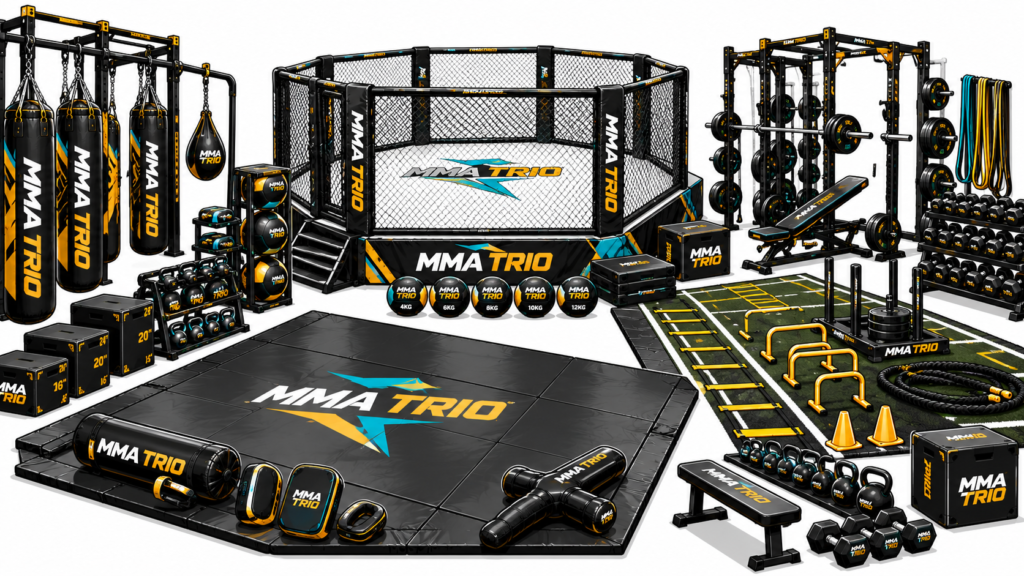
Striking is an important component of mixed martial arts. A training facility could include heavy bags, focus mitts, striking pads, and suitable floor space for practicing punches, kicks, defensive movement, and combinations.
Coaches could organize individual sessions or rotate team members through different stations.
For example, one fighter might practice pad work while another works on footwork and the third reviews a technique with the coach. They could rotate through the exercises so each athlete receives instruction.
Equipment should be securely installed, regularly inspected, and positioned so athletes can train without entering another person’s working area.
3. A Grappling and Wrestling Area
MMA fighters also need to practice wrestling, takedown defense, ground positioning, escapes, and submission techniques.
A dedicated grappling area with appropriate mats could support these activities. The surface should provide suitable cushioning and traction for the intended exercises.
Coaches should establish clear boundaries and supervise drills involving takedowns or ground fighting.
For an MMA Trio facility, grappling practice could include individual technical sessions as well as controlled team exercises that develop communication and awareness. The specific exercises would depend on the competition rules being explored.
4. A Strength and Conditioning Area
Strength and conditioning equipment could help athletes develop the physical abilities needed for mixed martial arts.
Depending on the facility’s budget and available space, equipment might include:
- Dumbbells and adjustable weights.
- Resistance bands and cable equipment.
- Exercise mats and stability equipment.
- Jump ropes and agility cones.
- Stationary bicycles or other aerobic training machines.
- Medicine balls and other suitable conditioning tools.
A gym would not need every piece of equipment immediately. It could begin with essential items and expand as the number of athletes and training requirements grow.
Coaches should design strength and conditioning programs around each fighter’s experience, abilities, and recovery needs.
5. A Team Strategy and Review Area
An MMA Trio facility could benefit from a dedicated space for coaches and teammates to discuss their training plans.
This area might include a whiteboard, seating, a display screen, and a place to review training footage.
Teams could use the space to discuss individual responsibilities, review techniques, identify mistakes, and prepare for upcoming training sessions.
These activities would be particularly relevant to a proposed team format in which communication and coordinated decisions might influence performance.
For more on how teammates could work together, read **[MMA Trio Teamwork: Why Communication Could Decide a Fight](https://mmatrio.com/mma-trio-teamwork-why-communication-could-decide-a-fight/).**
6. Protective Equipment and Storage
A training facility needs an organized place to store and maintain its equipment.
Depending on the activities offered, this could include gloves, shin guards, mouthguards, appropriate head protection for selected drills, training pads, and other protective equipment.
Storage areas should keep equipment organized and allow items to dry properly after use. Shared equipment should be cleaned according to appropriate hygiene practices.
Coaches should select protective equipment based on the exercise and the participants. Protective gear does not eliminate the risk of injury, so safe instruction and appropriate supervision remain essential.
For more on equipment choices, see **[MMA Trio Equipment and Protective Gear: What Would Fighters Need?](https://mmatrio.com/mma-trio-equipment/).**
7. Safety and First-Aid Facilities
Safety should be considered when planning any combat sports facility.
An MMA Trio gym could need accessible first-aid supplies, emergency contact procedures, clear exits, appropriate ventilation, clean training surfaces, and a plan for responding to injuries.
Staff should know how to stop an exercise when necessary and how to obtain emergency medical assistance.
The facility should also have clear rules covering supervised sparring, equipment use, hygiene, and reporting injuries.
If the gym eventually hosts organized competitions, additional requirements could apply, including those established by relevant athletic commissions, building authorities, fire officials, and other regulators.
How Could a Gym Accommodate Three-Fighter Teams?
The main difference between a conventional MMA training session and a team-focused session might be the way the space is organized and used.
A coach could arrange training stations so teammates can practice separate skills before coming together for coordinated exercises.
For example, a session might include:
- Individual striking and defensive technique practice.
- Grappling and wrestling instruction.
- Shared footwork and communication drills.
- Supervised team strategy exercises.
- A review session to discuss progress and areas for improvement.
Not every exercise would require all three fighters to work simultaneously. Rotating through stations could give each athlete focused instruction while making efficient use of the facility.
Any drill involving multiple active opponents would require particular attention to the competition format, safe spacing, supervision, and contact limits.
For practical exercise ideas, explore **[MMA Trio Training Drills: Exercises for Team Coordination](https://mmatrio.com/mma-trio-training-drills-exercises-for-team-coordination/).**
Could an Existing MMA Gym Support MMA Trio Training?
Yes. An existing MMA gym could potentially support many of the training requirements without a major renovation.
A facility that already has grappling mats, striking equipment, strength equipment, and qualified coaches may only need to adjust its scheduling and introduce suitable team coordination exercises.
Before making changes, gym owners could assess the available floor space, the number of athletes training at one time, equipment placement, and the activities planned.
If the facility is too crowded for a particular drill, the coach could divide the team into smaller groups or schedule the exercise for a quieter period.
A dedicated MMA Trio facility might eventually become useful if the format develops enough interest to justify specialized space. However, an entirely separate gym would not be a requirement for exploring the concept.
What Would an MMA Trio Gym Cost to Set Up?
The cost would depend on the location, size of the facility, condition of the building, equipment choices, insurance, and local regulatory requirements.
An existing gym adding team training could have much lower initial costs than someone opening a new facility from scratch.
Potential expenses could include:
- Rent, utilities, and any required building improvements.
- Flooring, mats, and installation.
- Striking bags, pads, and protective equipment.
- Strength and conditioning equipment.
- Storage, cleaning supplies, and first-aid resources.
- Insurance, permits, and qualified coaching staff.
These are categories of potential expenses, not a verified price estimate. Actual costs would need to be researched for the intended location and facility size.
A practical approach would be to begin with essential training equipment, use existing resources where appropriate, and add specialized features only when there is a clear need.
How Could Gym Design Support Fighter Safety?
Facility layout can influence how safely athletes train.
Equipment should be positioned to maintain clear walkways and prevent people from crossing active training areas unnecessarily. Training surfaces should be inspected regularly, and damaged equipment should be repaired or removed from use.
Coaches should also consider how many athletes can safely use an area at one time.
Other useful measures could include:
- Maintaining clear emergency exits and access routes.
- Providing adequate lighting and ventilation.
- Establishing cleaning procedures for mats and shared equipment.
- Keeping first-aid supplies accessible.
- Providing appropriate supervision for higher-risk activities.
- Establishing procedures for suspected concussions and other significant injuries.
If an MMA Trio format eventually permits simultaneous team engagement, the training and competition environments would require careful review by qualified medical professionals, coaches, and regulatory authorities.
A larger training space alone would not resolve every safety concern.
Frequently Asked Questions
Does an MMA Trio gym need a full-size cage?
Not necessarily. A gym could use appropriate mats and training areas for many activities. A competition-sized enclosure might be useful for specific practice scenarios, but its suitability would depend on the proposed rules and facility requirements.
Can three MMA Trio fighters train in a regular MMA gym?
Yes. An existing MMA gym could support team training if it has suitable space, equipment, qualified instruction, and an appropriate schedule.
What equipment should an MMA Trio gym purchase first?
The initial priorities could include suitable mats, basic striking equipment, protective gear, first-aid supplies, and essential conditioning equipment. Purchases should reflect the athletes’ needs, available budget, and planned training activities.
Would MMA Trio require a special training facility?
Not necessarily. The proposed format could be explored in an existing MMA gym. A specialized facility might become useful if future competition rules or training requirements create a clear need for one.
Are there official MMA Trio gym requirements?
No standardized MMA Trio facility requirements are assumed in this article. Any future organized competition would need to consider applicable regulations, medical guidance, building codes, and safety standards.
Final Thoughts
An MMA Trio training facility could combine the essential features of a traditional MMA gym with additional opportunities for team coordination and strategy development.
Suitable training areas, striking and grappling equipment, conditioning resources, protective gear, and safety procedures could provide a foundation for preparing three-fighter teams.
The facility would not necessarily need to be large or expensive from the beginning. An existing MMA gym could potentially accommodate the concept with thoughtful scheduling, suitable equipment, and qualified instruction.
As MMA Trio develops, its final competition rules and safety requirements would help determine whether specialized facilities or additional training resources become necessary.
Continue reading: MMA Trio Team Matchups: How Could Different Fighting Styles Work Together?