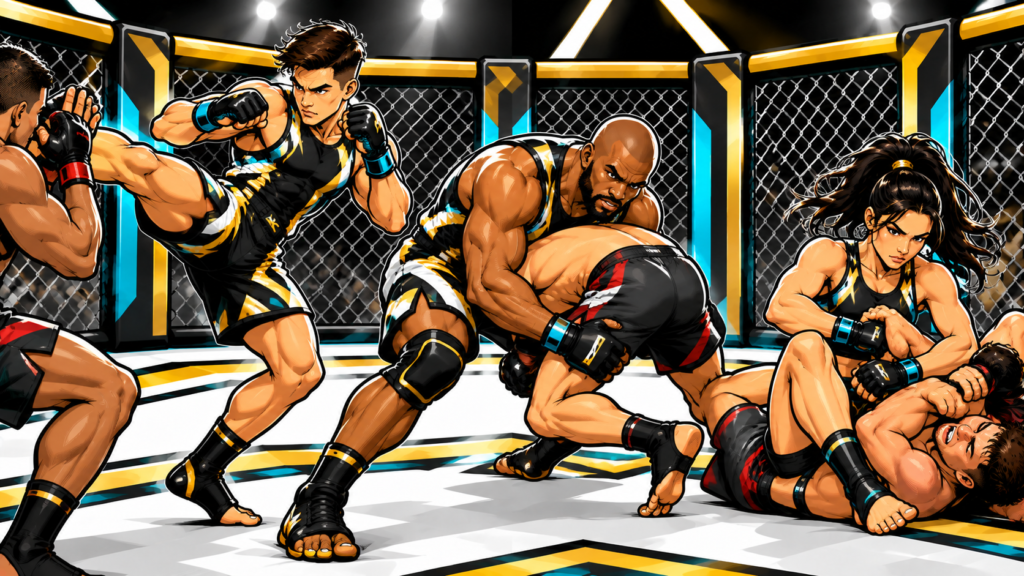
In mixed martial arts, fighters develop different strengths. Some excel at striking, others specialize in wrestling, and some are particularly skilled at grappling and submissions. In MMA Trio, a proposed three-on-three mixed martial arts format, these differences could become an important part of team selection.
Instead of relying on three fighters with identical strengths, a team might benefit from combining complementary skills. A strong striker, a skilled wrestler, and an experienced grappler could offer different ways to approach a match.
But would mixing fighting styles automatically create a stronger team? Not necessarily. The fighters would need to understand their responsibilities, communicate effectively, and train together.
Let’s explore how different fighting styles could work together in MMA Trio.
Why Would Fighting Styles Matter in MMA Trio?
Every fighter has strengths and weaknesses. A striker might be comfortable fighting on the feet but need to improve defensive wrestling. A wrestler might excel at controlling opponents but need to develop stronger striking skills. A submission specialist might be particularly dangerous on the ground but need to improve takedown defense.
In a three-fighter team, these differences could influence how coaches select athletes and develop a shared strategy.
A balanced team might offer several technical strengths without relying too heavily on one approach. However, MMA fighters generally need well-rounded skills, and no team should assume that one athlete can completely compensate for another’s weaknesses.
The goal would be to combine individual strengths while building a team that can respond to different opponents and situations.
Three Fighting Styles That Could Complement Each Other
1. The Striker: Controlling the Standing Exchanges
A striker specializes in techniques such as punches, kicks, knees, and other permitted standing attacks. Depending on the athlete’s background, that fighter might have experience in boxing, kickboxing, Muay Thai, or the striking portion of MMA.
A striker could bring several strengths to a team:
- Accurate and effective standing attacks.
- Good distance management and footwork.
- The ability to recognize openings in an opponent’s defense.
- Experience defending against and responding to strikes.
In a proposed MMA Trio team, a striker could help the team prepare for opponents who prefer standing exchanges.
However, striking ability alone would not be enough. The fighter would still need competent takedown defense, ground awareness, and the ability to adapt to different match situations.
2. The Wrestler: Takedowns and Positional Control
A wrestler may specialize in takedowns, balance, clinch control, and maintaining dominant positions.
These skills could provide a different dimension to a team that also includes a striker and a grappler.
A wrestler might contribute:
- Strong takedown technique.
- Balance and positional awareness.
- The ability to defend against an opponent’s takedown attempts.
- Experience controlling movement and managing physical pressure.
Wrestling can be valuable in MMA, but the rules of a future MMA Trio competition would determine how takedowns and positional control affect the result.
A wrestler would also need to develop effective striking defense and understand the submission threats that can arise during ground exchanges.
3. The Grappler: Ground Skills and Submission Defense
A grappler may specialize in Brazilian jiu-jitsu, submission wrestling, or other forms of ground fighting.
Depending on the athlete’s background, these skills could help the team prepare for situations involving ground control, escapes, positional transitions, and submission attempts.
A grappler might contribute:
- Knowledge of submission techniques and defenses.
- The ability to escape difficult ground positions.
- Strong positional awareness.
- An understanding of how opponents transition between ground positions.
These abilities could complement a teammate whose strengths lie primarily in striking or wrestling.
As with the other roles, a grappler would still need to be capable of handling the broader demands of mixed martial arts.
Would a Balanced Team Be Better Than Three Similar Fighters?
Imagine two hypothetical MMA Trio teams.
Team A: Three primarily striking specialists
All three fighters have strong standing attacks and similar technical backgrounds. They may share training methods and understand one another’s preferred approach.
However, the team might need to pay particular attention to wrestling defense, ground escapes, and opponents with strong grappling skills.
Team B: A striker, a wrestler, and a grappler
This team has a wider range of specialized strengths. Each fighter brings a different technical background, potentially giving the coach more options when preparing for different opponents.
However, the team could also face challenges. The fighters might have different training habits, different preferences, and different ideas about how to approach a difficult situation.
Neither team would automatically be superior. Team A could have excellent coordination and well-rounded individual skills, while Team B could struggle if its members fail to work together.
The better matchup would depend on the athletes’ overall abilities, conditioning, preparation, compatibility, and the competition rules.
How Could Coaches Choose the Right Three Fighters?
Selecting a team would involve more than choosing one fighter from each discipline.
Evaluate Individual Strengths
Coaches could assess each athlete’s striking, wrestling, grappling, conditioning, defensive skills, and experience.
This would help identify both strengths and areas that need improvement.
Look for Complementary Skills
A coach might consider whether one fighter’s strengths could complement another’s. The goal would be to create a team with several useful technical options rather than three athletes who all depend on the same approach.
Consider Compatibility
Technical ability matters, but so does the ability to work together.
Fighters would need to communicate, respect one another, and develop a shared understanding of their strategy.
Test the Team During Training
Coaches could use controlled drills and supervised practice scenarios to evaluate how well the fighters coordinate their decisions.
Training could reveal problems that would not be obvious when evaluating athletes individually.
For a deeper look at team responsibilities, read MMA Trio Fighter Roles: Building a 3-on-3 Team.
How Could Different Fighting Styles Train Together?
Combining different backgrounds would require a training plan that brings the athletes together without neglecting individual development.
Practice Shared Fundamentals
All three fighters should continue developing essential MMA skills, including striking defense, takedown defense, ground awareness, and safe transitions.
Specialization should not become an excuse to ignore weaknesses.
Learn Each Teammate’s Strengths
Training partners could study one another’s preferred techniques and understand where each fighter is most effective.
This knowledge could help coaches develop a strategy that suits the team’s abilities.
Use Controlled Scenario Drills
Coaches could create supervised exercises that challenge fighters to respond to different technical situations. These drills should follow appropriate safety precautions and the rules of the training environment.
Review Performance Together
After training, the team could review what worked, identify communication problems, and adjust its approach.
For more on coordinating preparation, see MMA Trio Teamwork: Why Communication Could Decide a Fight.
Could Different Fighting Styles Create Tactical Advantages?
A team with complementary skills might have more options when responding to different opponents.
For example, a team facing strong strikers might prioritize defensive movement and takedown defense during preparation. Against skilled wrestlers, the team might devote additional attention to balance, takedown prevention, and ground escapes.
These are examples of preparation strategies, not guaranteed advantages.
The actual approach would depend on the opponent, the individual matchup, and the rules of MMA Trio. If the format allowed multiple fighters to engage the same opponent simultaneously, that would introduce additional tactical and safety considerations requiring clear regulations.
Until a standardized ruleset exists, the precise strategic advantages of particular team combinations remain hypothetical.
Frequently Asked Questions
Should an MMA Trio team have a striker, a wrestler, and a grappler?
That could be one possible team structure. However, coaches should evaluate each fighter’s complete skill set rather than rely exclusively on a primary specialty.
Can three fighters with the same fighting style succeed?
Potentially. A team with similar backgrounds could benefit from shared experience and consistent training. Its success would depend on individual ability, adaptability, and the team’s preparation.
Does every MMA Trio fighter need to be well-rounded?
A well-rounded skill set would likely be valuable. Even specialists would need to prepare for the striking, wrestling, and grappling situations that can arise in mixed martial arts.
How would coaches determine which team combination is best?
Coaches could evaluate technical ability, conditioning, compatibility, training performance, and the proposed rules of competition. Actual competitive results would eventually provide stronger evidence than theory alone.
Final Thoughts
MMA Trio could make team selection an interesting part of a three-on-three mixed martial arts format. Combining strikers, wrestlers, and grapplers might give a team a broader range of technical strengths, but the right combination would depend on the athletes and how effectively they work together.
A successful team would need more than three specialists. It would need fighters who can adapt, communicate, train together, and maintain the fundamental skills required for mixed martial arts.
As MMA Trio develops as a concept, the relationship between individual fighting styles and team strategy will remain an important question to explore.
Continue reading: MMA Trio Teamwork: Why Communication Could Decide a Fight