What Actions Should Be Prohibited?
Every combat sport needs rules that explain what fighters can and cannot do. Without clear restrictions, competitors could use dangerous techniques, gain unfair advantages, or put their opponents at unnecessary risk.
In MMA Trio, these rules are especially important because three fighters compete as a team. A foul committed by one competitor could affect the individual match, the team’s score, or even the team’s ability to continue competing.
So what should count as a foul in MMA Trio? Should the competition follow traditional MMA restrictions, or should a three-on-three format introduce additional rules to address team interference and multiple competitors?
The best starting point would be to use established MMA safety rules and determine whether additional restrictions are needed for team competition. This article explains common MMA fouls and how they could be handled in MMA Trio.
What Is a Foul in MMA?
A foul is an action that violates the rules of a competition. It may be intentional or accidental, but it can still result in a warning, penalty, point deduction, or disqualification depending on the circumstances and applicable regulations.
Traditional MMA rules prohibit actions that are considered dangerous, unfair, or outside the permitted techniques of the sport.
Examples include:
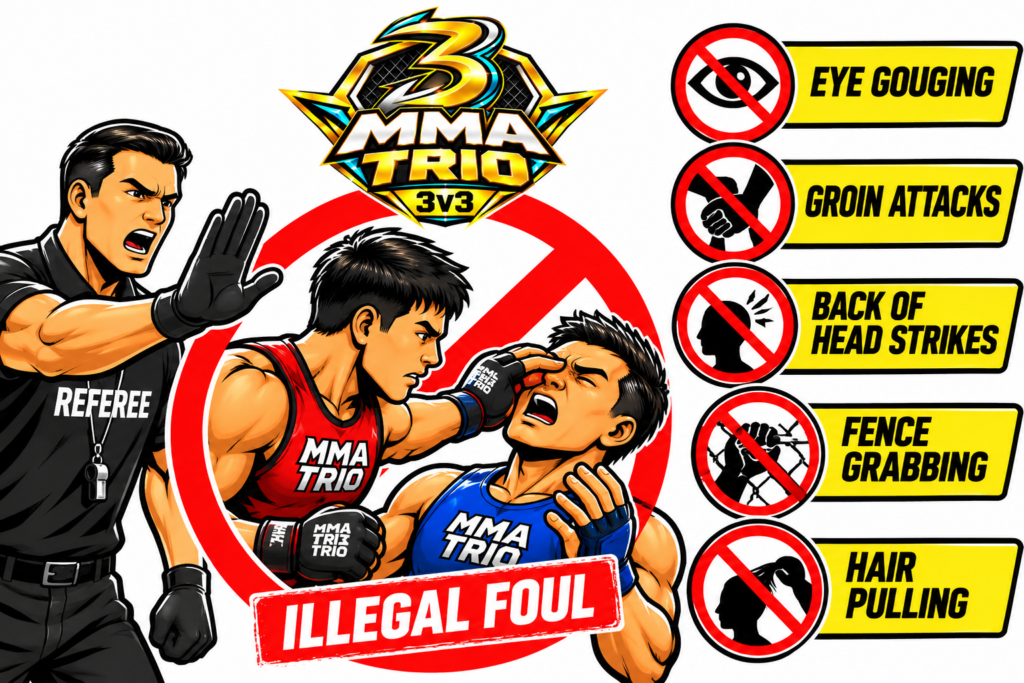
- Eye gouging or intentionally attacking an opponent’s eyes.
- Biting or spitting at an opponent.
- Hair pulling.
- Groin attacks.
- Striking the back of the head or spine.
- Holding an opponent’s gloves or shorts to gain an unfair advantage.
- Grabbing the cage or fence to control movement.
- Attacking an opponent after the referee has stopped the action.
The exact list and technical definitions can depend on the rules adopted by the athletic commission or sanctioning organization overseeing an event.
Which Actions Should Be Prohibited in MMA Trio?
A proposed MMA Trio rulebook could begin with the prohibited actions already recognized in established MMA regulations.
1. Eye Gouging and Attacks to the Eyes
Fighters should not intentionally use their fingers, thumbs, or other body parts to gouge or attack an opponent’s eyes.
Eye injuries can be serious and may affect a fighter’s ability to continue safely. Officials should treat intentional eye attacks as serious violations.
2. Biting and Spitting
Biting an opponent or deliberately spitting at them should be prohibited.
These actions have no place in a regulated combat competition and can create unnecessary health and safety concerns.
3. Hair Pulling
Grabbing or pulling an opponent’s hair to control their movement or gain a position should be prohibited.
Fighters should use legal grappling techniques rather than pulling hair to escape a hold or prevent an opponent from advancing.
4. Groin Attacks
Intentional attacks to the groin should be prohibited. This includes strikes, kicks, knees, or other deliberate actions directed at the area.
Competition rules should also explain how officials handle accidental low blows, including when the action is paused and how much recovery time may be allowed.
5. Strikes to the Back of the Head and Spine
Intentional strikes to prohibited areas of the head, neck, or spine should not be allowed.
These areas require special protection because attacks can cause serious injury. The exact boundaries of legal and illegal target areas should be explained during fighter briefings.
6. Illegal Strikes Against a Grounded Opponent
Some techniques that may be permitted against a standing opponent are restricted when an opponent is grounded.
Depending on the applicable MMA rules, prohibited actions may include certain kicks or knees to the head of a grounded opponent and stomping a grounded fighter.
Because definitions of a grounded fighter and permitted attacks can vary, MMA Trio organizers would need to adopt a specific regulatory standard rather than leave the interpretation unclear.
7. Holding Gloves, Shorts, or the Fence
Fighters should not gain an unfair advantage by grabbing an opponent’s gloves or shorts or by holding the cage fence with their fingers or toes.
For example, a competitor should not grab the fence to prevent a takedown or hold an opponent’s shorts to stop them from escaping.
These actions interfere with the normal techniques of the sport and should be addressed by the referee.
8. Dangerous Joint Manipulation
Small-joint manipulation, such as twisting individual fingers to force an opponent to release a hold, is prohibited under established MMA rules.
Legal submission techniques may involve larger joints and recognized grappling positions, but competitors must follow the specific restrictions of the competition.
9. Attacking After the Referee Stops the Fight
Once the referee stops the action, fighters must immediately follow the instruction.
Continuing to strike an opponent after a stoppage, attacking someone who is under the referee’s care, or deliberately ignoring instructions should be treated as serious misconduct.
10. Unsportsmanlike Conduct
Fighters should compete with discipline and respect for their opponents and officials.
Actions such as deliberately injuring an opponent through unsportsmanlike conduct, using abusive language in the fighting area, or flagrantly disregarding the referee’s instructions may result in penalties under applicable rules.
Could MMA Trio Have Additional Team-Related Fouls?
Traditional MMA rules were primarily designed for individual competitors. A three-on-three format may introduce situations that require additional clarification.
For example, MMA Trio would need to establish exactly how teammates may communicate, where they must remain, and whether they can enter or interfere with the fighting area.
The following are possible additional team-competition restrictions.
1. Interference From Teammates
A teammate who is not actively competing should not enter the fighting area, physically assist a fighter, or interfere with the referee’s ability to supervise the action.
Coaches and teammates could communicate from their designated area, but they should not interfere with the actual contest.
2. Unauthorized Assistance
A fighter should not receive physical assistance from another team member during an active exchange unless the official competition format specifically permits it.
This restriction would help distinguish legitimate team communication from actions that interfere with the individual contest.
3. Disobeying Referee Instructions
Every active competitor must follow the referee’s instructions. A fighter should not continue attacking, refuse to separate, or interfere with an official’s attempt to stop the action.
Repeated or serious violations could result in stronger penalties.
4. Deliberate Team Misconduct
MMA Trio may need a procedure for handling misconduct involving coaches, seconds, or other members of a team.
For example, a coach who repeatedly enters a restricted area or physically interferes with an opponent could create a serious safety issue.
Any team-level penalty would need to be clearly defined in advance. An individual fighter’s foul should not automatically result in punishment for two teammates who had no involvement.
What Happens When a Fighter Commits a Foul?
Not every foul requires the same response. The referee should consider the type of violation, its severity, whether it was intentional, and whether it caused an injury.
Traditional MMA regulations commonly provide several possible responses.
Verbal Warning
For certain minor or first-time violations, the referee may issue a warning and instruct the fighter to stop the illegal action.
A warning makes the competitor aware that repeating the action could result in a more serious penalty.
Point Deduction
A more serious foul may result in a point deduction under the applicable scoring rules.
In MMA Trio, organizers would need to determine whether a point deduction affects only the individual fighter’s score or also changes the team’s overall score.
That distinction should be established before competition begins.
Disqualification
A fighter may be disqualified for a sufficiently serious foul or a combination of violations when the applicable rules permit it.
Intentional actions that cause serious injury can have especially serious consequences.
For MMA Trio, the rules would also need to explain whether an individual disqualification automatically ends the team’s participation or whether the remaining competitors can continue.
Related Article: MMA Trio Scoring: How Could a 3-on-3 Fight Be Judged?
What Is the Difference Between an Intentional and Accidental Foul?
Not every illegal action happens deliberately. A fighter may accidentally make contact with a prohibited area while attempting a legal technique.
The distinction matters because the referee may need to consider the circumstances before deciding what penalty or procedure applies.
Intentional fouls
An intentional foul occurs when a competitor deliberately performs an illegal action.
Examples could include deliberately striking an opponent in a prohibited area, grabbing the fence to avoid a takedown, or continuing to attack after the referee has ordered a stoppage.
Depending on the severity, the referee may issue a warning, deduct points, or disqualify the fighter.
Accidental fouls
An accidental foul occurs when an illegal action happens without deliberate intent.
For example, an accidental low blow may occur during a fast exchange. The referee may pause the action and follow the applicable recovery and medical procedures.
Accidental fouls can still have consequences. The outcome depends on the injury, the rules, and whether the affected fighter can continue.
Who Decides Whether a Foul Has Occurred?
The referee is responsible for supervising the fight and enforcing the applicable rules.
In traditional MMA, the referee determines whether a foul has occurred and can issue warnings, deduct points, or stop the contest as permitted by the governing regulations.
Judges should not independently impose a foul penalty that the referee has not assessed.
For MMA Trio, this responsibility would be especially important because officials may need to monitor several competitors and prevent interference between teams.
Organizers would need to establish how many referees are required, how officials communicate, and who has authority over the overall team competition.
How Could Fouls Affect an Entire MMA Trio Team?
One of the biggest differences between individual MMA and a team competition is how a penalty could affect the final result.
Consider a situation in which one fighter commits a serious foul while the other two teammates are competing fairly.
Should the entire team lose? Should only the offending fighter be penalized? Should the team lose points?
These are questions that MMA Trio organizers would need to address.
A possible starting approach would be:
- Individual warning: The offending fighter receives a warning for a violation that does not require a stronger penalty.
- Individual point deduction: The offending fighter receives a deduction under the applicable scoring system.
- Individual disqualification: A serious violation ends that fighter’s participation, subject to the competition rules.
- Team consequences: Additional team penalties apply only when a clearly defined team rule has been violated.
This approach would help avoid automatically punishing teammates who did not participate in the violation.
Related Article: MMA Trio Teamwork: Why Communication Could Decide a Fight
How Could MMA Trio Keep Its Rules Fair?
Fighters should understand the rules before stepping into the competition area. A clear rulebook would help competitors, coaches, referees, and organizers apply the same standards.
Possible measures include:
- Publish a complete list of prohibited actions.
- Explain the difference between intentional and accidental fouls.
- Establish consistent warning and penalty procedures.
- Define the referee’s authority and responsibilities.
- Explain how individual penalties affect team scoring.
- Establish rules for coach and teammate interference.
- Provide a fighter briefing before each event.
- Ensure that officials are trained to enforce the same standards.
These procedures would help make the competition easier to understand and supervise.
Frequently Asked Questions About MMA Trio Fouls
What actions should be illegal in MMA Trio?
MMA Trio could adopt established MMA restrictions against eye gouging, biting, hair pulling, groin attacks, prohibited strikes, small-joint manipulation, fence grabbing, and attacking after a stoppage. Additional team-interference rules may also be necessary.
Can a fighter be disqualified for one foul?
Yes. Under established MMA rules, a sufficiently serious or flagrant foul may result in immediate disqualification. The exact decision depends on the applicable regulations and the referee’s authority.
Does an accidental foul count as a violation?
An accidental foul can still be a rule violation, but the referee may handle it differently from an intentional foul. The injury, circumstances, and governing rules determine the appropriate procedure.
Can a coach or teammate be penalized for interference?
Yes. Traditional MMA rules address interference from a fighter’s corner or seconds. MMA Trio could establish additional procedures for team members who enter restricted areas or interfere with the competition.
Does one fighter’s foul automatically penalize the entire team?
Not necessarily. A proposed MMA Trio system could apply the penalty to the individual fighter unless a separate team rule has been violated. The team scoring rules would need to explain how any deduction affects the overall result.
Who enforces MMA Trio foul rules?
The referee would supervise the active competition and enforce the adopted rules. The relevant athletic commission or sanctioning organization would also have authority according to its regulations.
Final Thoughts: Clear Foul Rules Protect Every Fighter
Fouls are an unavoidable subject in any organized combat sport. The important thing is to establish clear restrictions and enforce them consistently.
MMA Trio could use established MMA rules as its foundation while adding carefully defined procedures for team interference, individual penalties, and team scoring.
Most importantly, the rules should protect all six competitors, not just the fighters who are actively winning or losing. No team should gain an advantage by using illegal actions, and no competitor should have to tolerate dangerous behavior because the format involves multiple fighters.
Clear foul rules would help make MMA Trio safer, fairer, and easier for athletes, officials, and spectators to understand.
Explore More: