How Would the Rules Work in a 3-on-3 Fight?
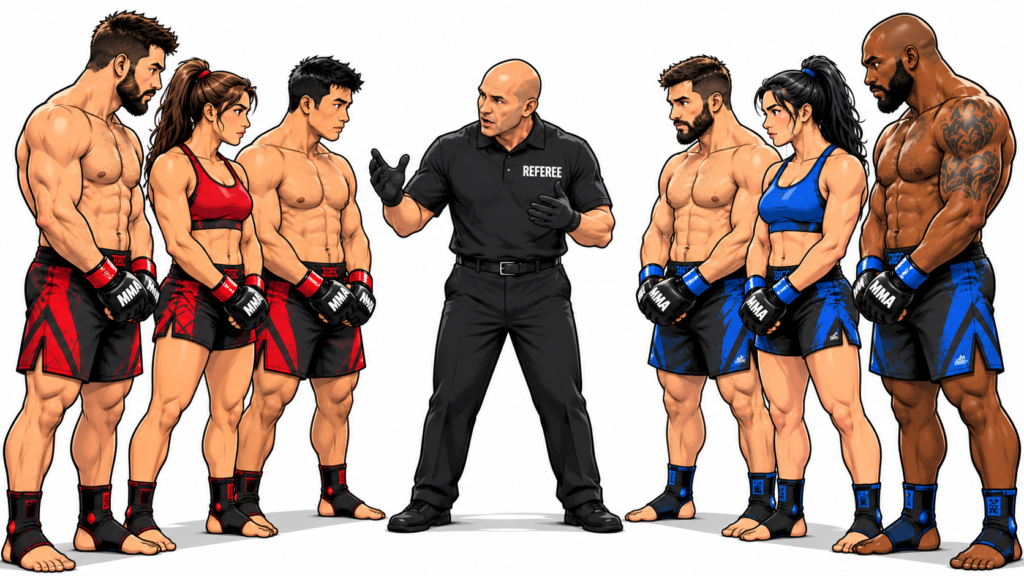
MMA Trio is a proposed combat sports format that brings six fighters into the competition area, with three fighters representing each team. Unlike traditional mixed martial arts, which generally features two competitors in a match, MMA Trio explores the possibility of team-based competition.
However, a three-on-three fight would need clearly defined rules before it could be conducted safely and fairly. How many fighters could engage at once? How would referees handle fouls? What would happen if one team lost a fighter?
This guide explores a possible rule framework for MMA Trio. These are proposed rules for the concept, not official regulations adopted by a recognized athletic commission or MMA organization.
1. How Many Fighters Would Compete?
The defining feature of MMA Trio is the three-versus-three format. Each team would begin with three eligible fighters, creating a total of six competitors.
A proposed basic rule would require each team to register its fighters before the match. Each competitor would need to satisfy the applicable medical, licensing, age, and eligibility requirements established by the event organizer and governing athletic commission.
The event rules would also need to establish whether all six fighters could engage simultaneously or whether the match would use controlled, alternating engagements. This distinction is important because the number of active fighters directly affects the safety and fairness of the competition.
To understand the overall concept, read What Is MMA Trio?
2. How Would Fighter Participation Work?
A central question for MMA Trio is how team members would be allowed to participate during a match.
One possible model would permit all three members of each team to participate at the same time, subject to strict limits on engagement, interference, and attacks involving multiple opponents. Another model could allow controlled one-on-one engagements while the remaining teammates wait for an authorized opportunity to enter.
Neither model should be treated as an established MMA Trio rule until the format is formally defined and reviewed for safety.
Proposed team participation requirements
- Each team must identify its three registered fighters before competition.
- Fighters must follow the event’s rules governing engagement and team assistance.
- Unauthorized attacks against a fighter who is already incapacitated or protected by the referee must be prohibited.
- Team members must not interfere with referee instructions or an official stoppage.
- The rules must explain whether and how a fighter may withdraw or be replaced.
Clear participation rules would help distinguish MMA Trio from a conventional MMA bout without leaving important safety decisions undefined.
3. What Attacks and Actions Would Be Prohibited?
MMA Trio would need an explicit list of permitted techniques and fouls. The organizer should not assume that rules designed for a conventional one-on-one MMA match will automatically address every situation involving six competitors.
Depending on the approved ruleset and applicable athletic commission, prohibited conduct could include:
- Eye gouging and other prohibited attacks to the eyes.
- Biting, hair pulling, or other prohibited forms of bodily abuse.
- Attacks to prohibited target areas.
- Illegal strikes or other techniques prohibited by the governing ruleset.
- Attacking a fighter after the referee has stopped the action.
- Interfering with the referee or deliberately obstructing an official stoppage.
- Continuing to attack an opponent who is incapacitated or no longer able to defend themselves.
The final list would need to be written into the official event rules and checked against the applicable commission’s requirements. The precise restrictions can vary by jurisdiction and ruleset.
4. How Would Referees Control a Three-on-Three Fight?
Referee control would be one of the most important parts of MMA Trio. A conventional MMA referee generally supervises two competitors. A three-on-three format could require the referee to monitor several exchanges and recognize when a fighter needs immediate protection.
A proposed officiating framework could include the following responsibilities:
- Enforce the approved rules and issue warnings or penalties.
- Stop illegal actions and prevent attacks from continuing after a stoppage.
- Assess whether a fighter can intelligently defend themselves.
- Coordinate with medical personnel when a competitor may be injured.
- Stop the match when necessary to protect a competitor.
- Apply the event’s predetermined procedures when a team or individual can no longer continue.
Before MMA Trio could operate as a real competitive event, organizers would need to determine the number of referees, their positioning, communication procedures, and authority to stop the contest.
5. How Would Scoring Work?
A three-on-three competition would need a scoring system that rewards effective fighting while discouraging reckless team tactics. Scoring should be defined before a match begins, not improvised during competition.
Several possible approaches could be considered:
Team-based scoring
Judges could evaluate the team’s overall performance using criteria established in advance. The rules would need to explain how individual actions contribute to the team’s result and how judges compare the effectiveness of each team.
Individual results contributing to a team result
Another possible model would combine individual outcomes to determine the team’s overall result. The organizer would need to specify how wins, stoppages, penalties, and incomplete contests affect the final score.
Match-ending decisions
The rules must explain whether a match ends when one fighter cannot continue, when an entire team can no longer compete, when a predetermined scoring threshold is reached, or when the scheduled time expires.
These are possible scoring models, not established MMA Trio scoring rules. A single consistent system would need to be selected and published before competition.
6. What Happens When a Fighter Cannot Continue?
A team-based fight raises an important question: what happens when one competitor is injured, disqualified, or otherwise unable to continue?
A proposed rule framework should address at least three situations:
- Medical stoppage: The referee stops the affected fighter’s participation and obtains medical assessment when necessary.
- Disqualification: The rules specify whether the offending fighter, the team, or both face a penalty, depending on the seriousness and circumstances of the violation.
- Team continuation: The rules explain whether the remaining teammates may continue and how the numerical imbalance affects the contest.
Automatic replacement of an injured fighter during an active exchange should not be assumed. Any substitution system would need to be expressly authorized, carefully controlled, and approved under the applicable competition rules.
7. Fighter Safety Must Come First
Team-based combat presents risks that require specific attention. If multiple opponents can attack one fighter simultaneously, the possibility of serious injury may increase. Referee visibility, rapid stoppages, and clear engagement limits would therefore be essential considerations.
A responsible MMA Trio ruleset should address:
- Pre-fight medical examinations and eligibility requirements.
- Appropriate protective equipment and approved competition conditions.
- Clear limits on simultaneous attacks and engagement.
- Immediate stoppages when a fighter cannot adequately defend themselves.
- Access to qualified medical personnel throughout the event.
- Post-fight medical assessment and required suspensions.
- Emergency procedures and independent officiating oversight.
Any proposed format would need review by qualified combat sports officials, medical professionals, and the relevant athletic commission before being used in an actual event. A creative competition format does not remove the organizer’s responsibility to protect participants.
8. How Would MMA Trio Differ From Traditional MMA Rules?
Traditional MMA rules are designed around a contest between two competitors. MMA Trio would need additional provisions to govern team participation, multiple engagements, team-level outcomes, and situations where one competitor can no longer continue.
The difference would not simply be the number of fighters. The competition would require a ruleset that explains how six participants interact while preserving fair competition, effective officiating, and fighter safety.
For a broader comparison, see MMA Trio vs. Traditional MMA: What’s the Difference?
You can also read How Would an MMA Trio Fight Work? for a discussion of how a potential match could unfold.
Conclusion: Defining the Rules for MMA Trio
MMA Trio offers a different way to explore mixed martial arts by placing three fighters on each side of a team-based contest. But the format would need much more than a larger number of competitors to become a workable sporting event.
Clearly defined participation rules, prohibited actions, referee authority, scoring, medical procedures, and match-ending conditions would all be necessary. The rules would also need to be reviewed and approved by the relevant authorities before an event could take place.
For now, these ideas provide a starting point for discussing how MMA Trio might be structured. Establishing a safe, consistent, and understandable ruleset would be an essential step in developing the concept further.
Related MMA Trio Articles
- What Is MMA Trio?
- How Would an MMA Trio Fight Work?
- MMA Trio vs. Traditional MMA: What’s the Difference?