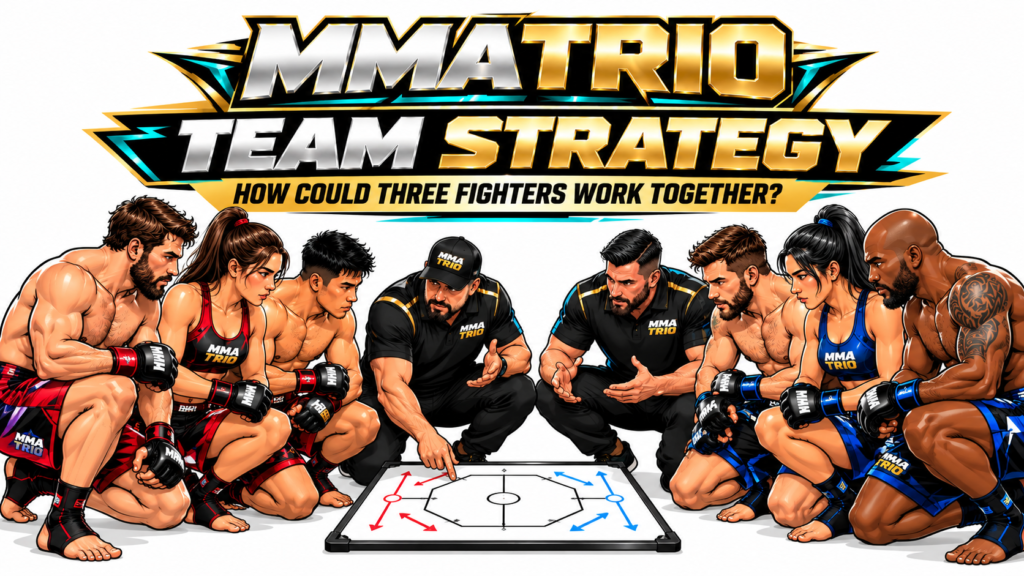
How Could Three Fighters Work Together?
In a team-based format, having three talented fighters would not automatically guarantee success. The way a team coordinates its abilities could be just as important as the skills of its individual members.
This article explores possible MMA Trio team strategies. These are conceptual examples, not established competition tactics or official rules for an approved MMA Trio event.
1. Why Would Team Strategy Matter in MMA Trio?
Traditional MMA generally focuses on a contest between two athletes. Each fighter prepares to deal with one opponent, although coaches may help develop a broader game plan before the bout.
MMA Trio introduces a different possibility: three teammates competing against three opponents within the same team-based format.
If the format permits coordinated team participation, fighters may need to consider how their individual strengths complement one another. They would also need to understand the limits imposed by the event’s rules, referee instructions, and safety requirements.
A team might have excellent strikers but limited grappling experience. Another might have strong wrestling skills but less experience controlling distance. A balanced combination of abilities could provide more options than relying on one type of fighter.
To understand the basic concept, start with What Is MMA Trio?
2. What Roles Could the Three Fighters Have?
One possible approach would be to build a team around complementary skills. These roles would not have to be fixed positions. Each fighter could contribute in different ways depending on the situation and the approved competition format.
The Striker
A striker specializes in techniques such as punches, kicks, and other permitted standing attacks. In a hypothetical MMA Trio team, a strong striker could contribute speed, timing, distance management, and accurate offensive techniques.
The team would still need to account for the opponent’s grappling ability and follow all rules governing legal targets and techniques.
The Grappler
A grappler may specialize in wrestling, takedowns, positional control, or submission techniques permitted by the ruleset. This skill set can provide a different set of options from a striker’s approach.
In a team format, the grappler’s role would depend on whether the event permits the relevant engagement and how the rules govern interactions among multiple competitors.
The All-Rounder
An all-rounder combines several aspects of MMA, including striking, grappling, defensive movement, and transitions between different positions.
A versatile fighter could give the team additional flexibility. However, the best role for any athlete would depend on their actual abilities, experience, physical condition, and the rules of the event.
These three roles are only one way to think about team composition. An effective team would not necessarily need exactly one striker, one grappler, and one all-rounder.
3. Why Would Complementary Fighting Styles Matter?
Three fighters with identical strengths might perform well in some situations, but they could also share the same weaknesses. A team with complementary abilities could have more ways to respond to different opponents.
For example, a team might include:
- A technically skilled striker with strong distance management.
- A wrestler with experience in takedown defense and positional control.
- A well-rounded fighter who can adapt to different styles.
This combination could offer a wider range of skills than a team that relies entirely on one approach. Nevertheless, success would depend on the individual athletes and the format rather than on any guaranteed formula.
Team selection should also account for experience, conditioning, temperament, defensive awareness, and the ability to follow instructions under pressure.
4. How Could Communication Improve Teamwork?
Communication can be important in any team sport. In a proposed MMA Trio format, competitors would need to understand the permitted ways to coordinate without violating competition rules or interfering with the referee.
Before a match, teammates could discuss their general approach, establish a shared understanding of their responsibilities, and practice responding to different situations.
Useful preparation could include:
- Agreeing on clear, simple communication signals where permitted.
- Practicing defensive awareness and safe movement in team exercises.
- Understanding each teammate’s strengths and limitations.
- Reviewing the event rules and the referee’s authority.
- Practicing how to respond when a teammate cannot continue.
Communication should never replace the referee’s instructions. If a referee stops the action or orders competitors to separate, all participants must follow the applicable rules immediately.
5. How Could a Team Adapt to Different Opponents?
Not every opposing team would have the same strengths. Some might favor striking, while others might have more experience in wrestling or grappling.
A team could prepare by studying general fighting styles, identifying potential challenges, and practicing ways to respond within the rules.
Facing a striking-focused team
A team might emphasize defensive movement, distance awareness, and protection against permitted strikes. Preparation could also include practicing responses to opponents with different reach, speed, and timing.
Facing a grappling-focused team
A team might place additional emphasis on takedown defense, positional awareness, and the ability to return to a safe standing position when appropriate.
Facing a balanced team
A versatile opposing team could require broader preparation. Rather than relying on one expected style, competitors might need to remain adaptable and make decisions based on what actually happens during the contest.
These examples describe general preparation concepts. They do not establish how fighters would be allowed to engage in an actual MMA Trio match.
6. Would Teamwork Change the Way Fighters Train?
Individual training would remain important. Each athlete would need to develop technical skills, conditioning, defensive ability, and sound judgment.
A team-based format could also create a need for additional training that focuses on cooperation and shared understanding.
Possible training priorities include:
- Technical practice tailored to the approved ruleset.
- Conditioning appropriate to the expected match duration.
- Defensive awareness and controlled movement around teammates.
- Communication and decision-making exercises.
- Practice scenarios supervised by qualified coaches.
- Review of fouls, stoppage procedures, and medical safety requirements.
Any training that simulates multiple opponents should be carefully supervised and designed to minimize unnecessary injury risk. Training should not encourage unsafe attacks or assume that every tactic used in a conventional MMA gym would be suitable for a team competition.
7. What Challenges Could MMA Trio Teams Face?
Team-based MMA would introduce challenges that go beyond selecting three skilled athletes.
Coordination
Competitors would need a shared understanding of their responsibilities. Poor coordination could cause confusion, particularly if the rules permit multiple simultaneous engagements.
Different levels of experience
A team with one highly experienced fighter and two less experienced athletes might have difficulty maintaining a consistent level of performance. Team selection and preparation would need to take individual abilities into account.
Fatigue and injury
Fatigue can affect reaction time, movement, and decision-making. If a fighter is injured or cannot continue, the remaining team members could face a different situation than they expected.
Rules and officiating
Team strategy would have to operate within a clearly defined ruleset. Participation limits, fouls, scoring, stoppages, and the referee’s authority would need to be established before a real event could take place.
For more on this subject, read MMA Trio Rules: How Would the Rules Work in a 3-on-3 Fight?
8. How Is MMA Trio Strategy Different From Traditional MMA?
Traditional MMA strategy generally centers on one fighter’s strengths, weaknesses, and approach to an individual opponent. Coaches may develop a game plan, but the competitor is responsible for executing it inside the cage.
MMA Trio could add another dimension by making the relationship among three teammates part of the strategic discussion.
Instead of evaluating only individual matchups, a team might also consider the balance of its members’ skills, communication, and how the competition’s rules affect their collective performance.
The degree to which teamwork would influence an actual contest depends on the format. If the rules restrict engagements to one-on-one exchanges, the strategic possibilities would differ considerably from a format that permits multiple simultaneous engagements.
Learn more in MMA Trio vs. Traditional MMA: What’s the Difference?
Conclusion: Could Teamwork Be the Key to MMA Trio?
MMA Trio presents an interesting opportunity to explore how three fighters might combine their skills in a team-based mixed martial arts format.
Complementary fighting styles, communication, preparation, adaptability, and a clear understanding of the rules could all be important considerations. However, no single team composition or strategy can guarantee success.
Before MMA Trio could become an organized competitive event, its format would need clear rules, appropriate officiating, and strong safety protections for every participant.
The concept raises an intriguing question: would a team of three individually outstanding fighters always outperform a team whose members work together more effectively? Exploring that question is part of what makes the MMA Trio concept interesting.
Related MMA Trio Articles
- What Is MMA Trio?
- How Would an MMA Trio Fight Work?
- MMA Trio vs. Traditional MMA: What’s the Difference?
- MMA Trio Rules: How Would the Rules Work in a 3-on-3 Fight?
Visit the MMA Trio Homepage for more articles exploring the three-on-three MMA concept.