
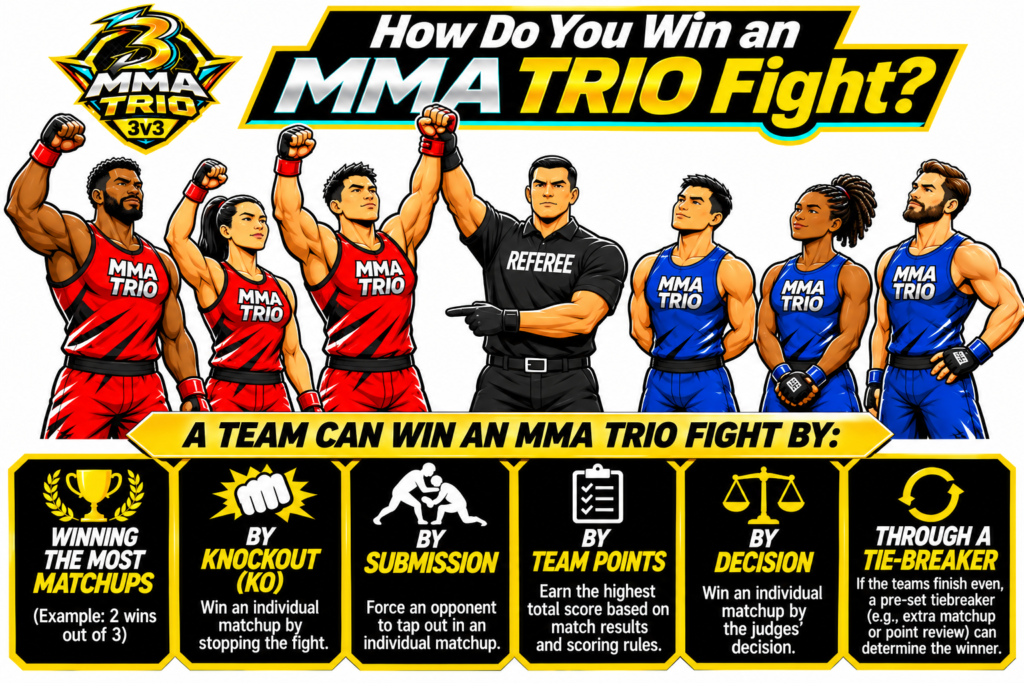
In traditional mixed martial arts, winning usually means defeating one opponent inside the competition area. But what happens when three fighters represent one team against three fighters from another team?
That is the central question behind MMA Trio. Instead of focusing exclusively on individual victories, this proposed 3-on-3 competition format introduces the possibility of an overall team victory.
For spectators and competitors, understanding how a team could win is an important part of understanding MMA Trio. Would every fighter need to win? Could one victory make the difference? What happens if the teams finish with equal results?
There are several possible ways to determine a winner. This article explores how an MMA Trio team could win, how individual performances might affect the final result, and what competition organizers would need to establish before adopting an official system.
1. Understanding the Goal of an MMA Trio Competition
The basic MMA Trio concept involves two teams, each consisting of three fighters. The teams compete against one another with the objective of achieving an overall victory.
Unlike a traditional individual MMA bout, the team format introduces another level of competition. A fighter’s performance could affect not only their own result but also the position of the entire team.
For example, imagine two teams competing:
- Team Red: Three fighters representing one side.
- Team Blue: Three fighters representing the opposing side.
Depending on the competition format, the fighters might compete in separate matchups, or organizers might develop another approved team-based structure.
The event rules would need to explain exactly how the overall winner is determined.
2. Winning Individual Matchups
One possible approach would be to have the three fighters from each team compete in separate individual matchups.
Each matchup would produce an individual result. Those results could then contribute to the team’s overall performance.
For example, a competition could produce the following results:
- Team Red wins the first matchup.
- Team Blue wins the second matchup.
- Team Red wins the third matchup.
Under a simple system in which each individual victory counts equally, Team Red would win two of the three matchups.
This approach would make every fighter’s performance important. A team could not depend entirely on one dominant competitor because the other matchups could determine the final result.
This is one possible competition model, not an officially established MMA Trio rule.
3. Could a Team Win Even If One Fighter Loses?
Yes. Under a team-based scoring system, it could be possible for a team to win the overall competition even if one of its fighters loses an individual matchup.
Consider this example:
- Team Red wins its first matchup.
- Team Red loses its second matchup.
- Team Red wins its third matchup.
If each matchup counts equally, Team Red would finish with two individual victories and one loss.
The team could still win the overall competition despite one fighter losing.
This is an important distinction between individual MMA and a team-based format. The overall result could depend on the combined performance of all three competitors rather than the outcome of just one fight.
4. Winning Through Team Points
Another possible approach would involve awarding points for different results.
For example, organizers could establish a system in which individual victories contribute points toward a team’s total. The team with the highest score at the end of the competition would win.
A possible points system might consider:
- Individual victories: Awarding points for winning a matchup.
- Finishes: Establishing additional points for a knockout, technical knockout, or submission, if the rules allow.
- Decisions: Awarding points when a fighter wins through the judges’ decision.
- Penalties: Deducting points when a team or competitor receives a penalty under the event rules.
However, organizers would need to decide whether different types of victories should receive different point values. A simple system in which every victory counts equally might be easier for spectators to understand.
For a more detailed discussion, read MMA Trio Scoring: How Could a 3-on-3 Fight Be Judged?
5. Can a Team Win Through a Knockout or Submission?
Knockouts and submissions are familiar ways to end individual MMA bouts. In a team competition, they could also have an impact on the overall result.
For example, if one fighter wins by knockout or submission, that individual result could count toward the team’s total.
Depending on the scoring rules, a finish might be worth the same as a decision victory, or it could receive additional points.
However, an individual finish would not automatically mean the entire team has won. The event rules would need to explain whether the remaining matchups continue and how the overall team result is calculated.
Fighter safety must remain the priority. Referees and medical personnel would need clear authority and procedures for stopping competition when necessary.
Learn more in MMA Trio Knockouts and Submissions: How Could They Affect the Team?
6. What Happens If Both Teams Finish With the Same Result?
A team competition needs a way to determine the winner when both sides finish with equal results.
For example, if Team Red wins one matchup and Team Blue wins one matchup, with the third matchup ending in a draw, the overall competition could finish tied under a simple win-counting system.
Possible tie-breaking methods could include:
- A designated additional matchup.
- A predetermined team-scoring procedure.
- A comparison of results under clearly defined event criteria.
- Another tie-breaking method announced before competition begins.
The method would need to be established in advance so that both teams understand how a winner will be determined.
For more information, read MMA Trio Draws and Tie-Breakers: How Could a Winner Be Decided?
7. Does Team Strategy Affect the Chances of Winning?
Individual skill would remain important, but team preparation could also influence the outcome of an MMA Trio competition.
Teams could consider several factors when preparing for an event:
- Fighter selection: Choosing competitors whose abilities complement one another.
- Opponent research: Studying the opposing fighters’ backgrounds and strengths.
- Matchup planning: Considering which competitors should face particular opponents when the format allows it.
- Physical preparation: Making sure all three fighters are prepared for the demands of competition.
- Communication: Developing a shared understanding of the team’s objectives and strategy.
Good preparation could help a team make better decisions, but no strategy can guarantee a victory. Each fighter would still need to perform under the event’s rules.
Explore this topic in MMA Trio Team Strategy.
8. What If a Fighter Cannot Continue?
An injury, medical stoppage, or other unexpected event could affect a team’s chances of winning.
Competition rules would need to explain what happens when a fighter cannot continue. Possible procedures could include ending an individual matchup, recording the result, or applying a previously established substitution policy.
A team should not be allowed to make an improvised replacement or continue under unclear conditions. Any substitution would need to follow the event’s eligibility, timing, and safety requirements.
Medical decisions must always take priority over the team’s desire to win.
For more information, read MMA Trio Medical Stoppages: When Should a Fight Be Stopped?
9. Why Should the Winning System Be Easy to Understand?
A good competition format should make it clear to fighters, officials, and spectators how a team wins.
If the scoring system is too complicated, spectators may struggle to understand the standings or know which team is ahead.
A clearly explained system should establish:
- How individual matchup victories are counted.
- Whether finishes receive additional points.
- How penalties affect team results.
- What happens when a matchup ends in a draw.
- How the overall team winner is announced.
These details should be published before an event begins. Both teams should compete under the same rules and understand how their performances contribute to the final result.
Frequently Asked Questions About Winning an MMA Trio Fight
How many fighters must win for a team to win?
That would depend on the competition’s scoring system. Under a simple three-matchup format, winning two of the three individual matchups could produce an overall team victory.
Can an MMA Trio team win if one fighter loses?
Yes. Under a team-based scoring system, a team could win two matchups and lose one while still earning the overall victory.
Does a knockout automatically win the entire team competition?
Not necessarily. A knockout could determine an individual matchup, but the overall team result would depend on the event’s rules and scoring system.
Can an MMA Trio competition end in a draw?
It could if the competition rules allow a tied result. Organizers would need to establish whether a tie-breaker or additional matchup would determine the winner.
Would all three fighters need to win?
Not necessarily. A team could win through a majority of individual victories or another approved team-scoring method.
Are the official MMA Trio winning rules established?
The exact winning system depends on the competition format being developed. The possible methods discussed in this article are examples, not officially adopted MMA Trio rules.
Final Thoughts: Winning as a Team
Winning an MMA Trio competition could involve more than having the strongest individual fighter. The three competitors would need to contribute to the team’s overall performance, whether through individual victories, points, or another established scoring method.
A team-based format could create interesting situations where one fighter loses but the team still wins, or where a single matchup makes the difference in a close competition.
The most important requirement is a clear and consistent system that explains how individual results contribute to the overall team victory.
As MMA Trio continues to develop, defining that system will be an important step toward creating a competition that fighters, officials, and spectators can understand.
Want to learn more? Visit the MMA Trio Frequently Asked Questions for more information about the 3-on-3 concept.
Previous Article: MMA Trio Scoring: How Could a 3-on-3 Fight Be Judged?
Next Article: MMA Trio Draws and Tie-Breakers: How Could a Winner Be Decided?