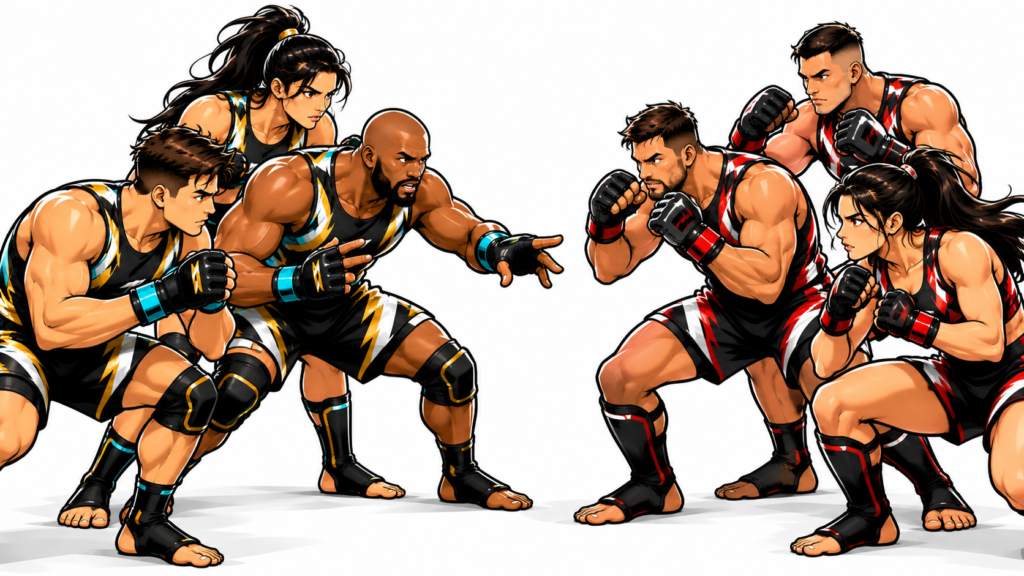
In MMA Trio, a proposed three-on-three mixed martial arts format, knowing when to attack and when to defend could be an important part of team strategy. Three fighters might bring different skills into the competition, but those skills would need to be used wisely.
Attacking at the wrong moment could leave a fighter vulnerable. Defending too much could allow an opponent to control the pace of a match. A team would need to recognize opportunities, manage risks, and understand when a change in strategy might be necessary.
So how could an MMA Trio team decide when to attack, when to defend, and when to adjust its approach?
Let’s explore the tactical decisions that could shape a three-on-three fight.
What Are Team Tactics in MMA Trio?
Team tactics are the decisions fighters and coaches make to pursue a competitive objective. They can include choosing an approach, responding to an opponent’s strengths, managing fatigue, and deciding when to prioritize offense or defense.
In traditional MMA, a fighter makes these decisions primarily for themselves. In a proposed MMA Trio format, team responsibilities could add another layer of complexity.
Depending on the rules, a fighter might need to consider not only their own position but also the team’s overall plan, the condition of their teammates, and the behavior of the opposing team.
The exact tactics would depend on how MMA Trio competition is eventually structured. For example, a format in which fighters compete in separate bouts would require different tactics from one that permits multiple fighters to engage at the same time.
When Should an MMA Trio Fighter Attack?
Attacking can create opportunities to score, gain an advantage, or force an opponent to respond. However, an attack should be based on a reasonable assessment of the situation rather than simply a desire to keep moving forward.
1. When a Clear Opportunity Appears
A fighter might recognize an opening when an opponent loses balance, leaves a defensive position exposed, or makes a predictable movement.
Good timing could allow the fighter to use their technical skills more effectively. However, an apparent opening might also be a setup for a counterattack.
Fighters would need to assess the situation carefully and avoid taking unnecessary risks.
2. When the Team’s Strategy Supports It
A fighter’s decision should fit the team’s agreed-upon approach whenever possible.
For example, a team might decide to use a patient, defensive approach against an opponent known for aggressive striking. Another matchup might call for a more active offensive strategy.
The important point is that a fighter should understand the plan and know when it makes sense to adapt.
3. When the Fighter Can Maintain a Strong Defense
An attack should not automatically mean abandoning defensive responsibility.
Fighters need to consider their balance, positioning, and ability to respond if an opponent counters. A poorly controlled attack could expose a fighter to strikes, takedowns, or other permitted techniques.
Effective offense involves creating opportunities while remaining prepared to defend.
When Should an MMA Trio Fighter Defend?
Defense is not simply a passive response. It can help a fighter avoid unnecessary damage, regain a favorable position, and prepare for a better opportunity.
1. When an Opponent Has the Advantage
If an opponent is applying pressure or creating dangerous openings, a fighter may need to prioritize defense rather than immediately trying to counterattack.
That could mean protecting against strikes, maintaining balance, defending a takedown, or working to escape an unfavorable position.
A patient defensive response could help the fighter regain control instead of making a rushed decision.
2. When Fatigue Affects Performance
Fatigue can affect reaction time, coordination, judgment, and defensive technique.
A tired fighter may need to manage their pace and avoid unnecessary exchanges. Coaches and teammates could help identify signs that the current approach is no longer working.
Any team strategy should still respect the fighter’s safety. A teammate should never be expected to continue competing through an injury or medical problem.
3. When Protecting Against a Counterattack
An aggressive opponent may try to exploit a fighter who commits too heavily to offense.
Maintaining defensive awareness can reduce avoidable risks. Fighters could practice recognizing common counterattacks and returning to a balanced position after attempting a technique.
The objective is not to eliminate all risk, which is impossible in combat sports, but to make informed decisions.
How Could Three Teammates Coordinate Their Tactics?
In MMA Trio, the relationship between individual decisions and team strategy could be particularly important. The best approach would depend on the rules, but several principles could apply to team preparation.
Agree on Responsibilities Before the Match
Before competition, teammates could discuss their strengths, preferred approaches, and responsibilities within the team’s overall strategy.
They should understand what the plan requires and how it might change if an opponent uses an unexpected tactic.
For more on assigning responsibilities, read MMA Trio Fighter Roles: Building a 3-on-3 Team.
Communicate Clearly
Brief, agreed-upon signals could help teammates share observations and maintain a common understanding of the plan, if communication is permitted under the competition rules.
Communication would need to remain clear and useful rather than distract fighters from immediate threats.
For more on coordinating preparation, see MMA Trio Teamwork: Why Communication Could Decide a Fight.
Adapt When the Original Plan Stops Working
A team should not assume its initial strategy will remain effective throughout a match.
If an opponent’s approach creates problems, the team may need to reconsider its priorities. Training could help fighters recognize when to continue with the plan and when to make a controlled adjustment.
This flexibility would be especially important in a new competition format where the most effective team tactics have not yet been established through actual competition.
Could Different Fighting Styles Change the Attack-or-Defend Decision?
Yes. Different technical strengths could influence how a team prepares for a matchup.
A striker might focus on distance management, effective defense, and identifying safe opportunities to use standing attacks. A wrestler might emphasize balance, takedown defense, and positional control. A grappler might focus on ground positioning, escapes, and submission defense.
These are examples of individual specialties, not rigid assignments. All three fighters would still need the fundamentals required for mixed martial arts.
Coaches could assess the opposing team’s abilities and help each fighter prepare for the challenges most relevant to their matchup.
Explore this subject in MMA Trio Team Matchups: How Could Different Fighting Styles Work Together?.
How Could Teams Practice Better Tactical Decisions?
Tactical judgment can be developed through structured training, coaching, and review.
Practice Controlled Scenarios
Coaches could create supervised exercises in which fighters practice responding to different offensive and defensive situations. The scenarios should have clear objectives, appropriate intensity, and safety precautions.
Review Decisions After Training
After a session, fighters could discuss when an attack was effective, when defense should have taken priority, and what information might have improved their decisions.
Video review could also help identify repeated mistakes.
Train Under Different Conditions
Teams could practice against partners with different styles and levels of pressure. This would help fighters learn to adapt instead of relying on one predictable approach.
Training should be supervised by qualified coaches, with suitable protective equipment and appropriate medical precautions.
For more preparation ideas, read MMA Trio Training: Preparing for a 3-on-3 Fight.
What Rules Would MMA Trio Need for Team Tactics?
Tactics cannot be separated from the rules of competition.
Before MMA Trio could operate as a regulated sport, its organizers would need to define how matches work, which actions are permitted, how officials intervene, and how fighters are protected.
If simultaneous team engagement were permitted, the rules would need to address situations involving multiple fighters, including how officials could identify fouls, protect an injured competitor, and stop dangerous exchanges.
Rules would also need to clarify whether teammates could communicate during a match, whether outside coaching would be allowed, and what conduct would count as interference.
These questions remain part of developing the proposed format. They should be resolved through qualified regulatory, medical, coaching, and officiating input before any real competition takes place.
Read MMA Trio Rules: How Would the Rules Work in a 3-on-3 Fight? for more on the proposed rules.
Frequently Asked Questions
Should MMA Trio fighters attack or defend more often?
Neither approach is always best. Fighters would need to respond to the situation, their opponent’s abilities, their own condition, and the team’s agreed-upon strategy.
Could teamwork make a difference in tactical decisions?
Teamwork could help fighters share information, understand responsibilities, and adjust their approach. Its actual effect would depend on the competition rules and the team’s preparation.
Should every fighter have the same tactical role?
Not necessarily. Different fighters may have different strengths, but each should understand the team’s overall strategy and maintain the skills needed to respond safely to changing situations.
Are MMA Trio team tactics already established?
No standardized MMA Trio ruleset or established competitive record is assumed here. The tactics discussed in this article are possibilities for a proposed three-on-three format, not proven rules or established competitive practices.
Final Thoughts
Knowing when to attack and when to defend could be an important part of MMA Trio. A fighter would need to recognize opportunities, protect against unnecessary risks, and understand how individual decisions fit into the team’s overall plan.
The strongest approach would not necessarily be the most aggressive one. Good tactical judgment could involve patience, adaptability, communication, and the ability to recognize when a situation has changed.
As the MMA Trio concept develops, these questions can help shape discussions about team strategy, fighter preparation, and the rules needed for a safe and organized competition.
Continue reading: MMA Trio Attack and Defense: Strategies for a 3-on-3 Fight